
Digital Transformation in the Age of AI: What It Really Means — and Why It Pays Off
YL
Every industry conversation today seems to circle back to the same phrase: digital transformation. It shows up in boardroom strategy decks, vendor pitches, and LinkedIn posts, often used so loosely that it starts to feel like a buzzword rather than a concrete business strategy. But behind the hype is a real, measurable shift in how organizations operate — and for companies that get it right, the payoff in cost savings and efficiency can be substantial.
This post breaks digital transformation down into plain terms, looks at the hard numbers behind AI-driven cost savings and efficiency gains, and explains how organizations that don't have this expertise in-house can get help — including from firms like Xcellent Life, which brings decades of hands-on technology and automation experience to the table.
Part 1: What Digital Transformation Actually Means

At its core, digital transformation is the process of integrating digital technology into every part of a business — fundamentally changing how the organization operates, makes decisions, and delivers value to customers. It's not just about buying new software or moving files to the cloud. It's a structural and cultural shift in how work gets done.
A useful way to think about it: digitization converts analog information into digital form (paper records into files, for example). Digital transformation goes several steps further — it redesigns processes, business models, and even organizational culture around what digital tools now make possible.
This shift touches nearly every function of a business:
- Operations: automating manual workflows, connecting previously siloed systems, and using data to drive decisions in real time
- Customer experience: personalized, omnichannel interactions powered by data and AI
- Decision-making: faster, more accurate insights instead of gut-feel or delayed reporting
- Culture: teams that are equipped and expected to use digital tools as part of daily work, not as an afterthought
The scale of investment tells its own story. Global spending on digital transformation technologies and services is projected to approach $3.9 trillion by 2027, according to IDC — and could make up more than two-thirds of all information and communication technology spending by that point. Large enterprises are increasingly leading the charge, but small and midsize businesses are catching up quickly: by 2027, roughly half of small and medium-sized businesses are expected to significantly restructure their IT budgets specifically to prioritize AI technologies.
Why does this matter so much right now? Because the pace of change has shifted from incremental to exponential. AI — and generative AI in particular — has changed what's technically possible in a way that legacy digitization efforts (like early ERP systems or basic cloud migration) never did. Work that once required teams of people sorting through documents, routing tickets, or reconciling spreadsheets can now be handled, in large part, by intelligent systems that learn, adapt, and act with minimal human oversight.
That's the real story of digital transformation today: it's no longer just about going digital. It's about going intelligent.
Part 2: The Business Case — Cost Savings and Efficiency Gains from AI
This is where digital transformation stops being an abstract strategic goal and starts becoming a line item on the balance sheet.
The macro numbers are enormous
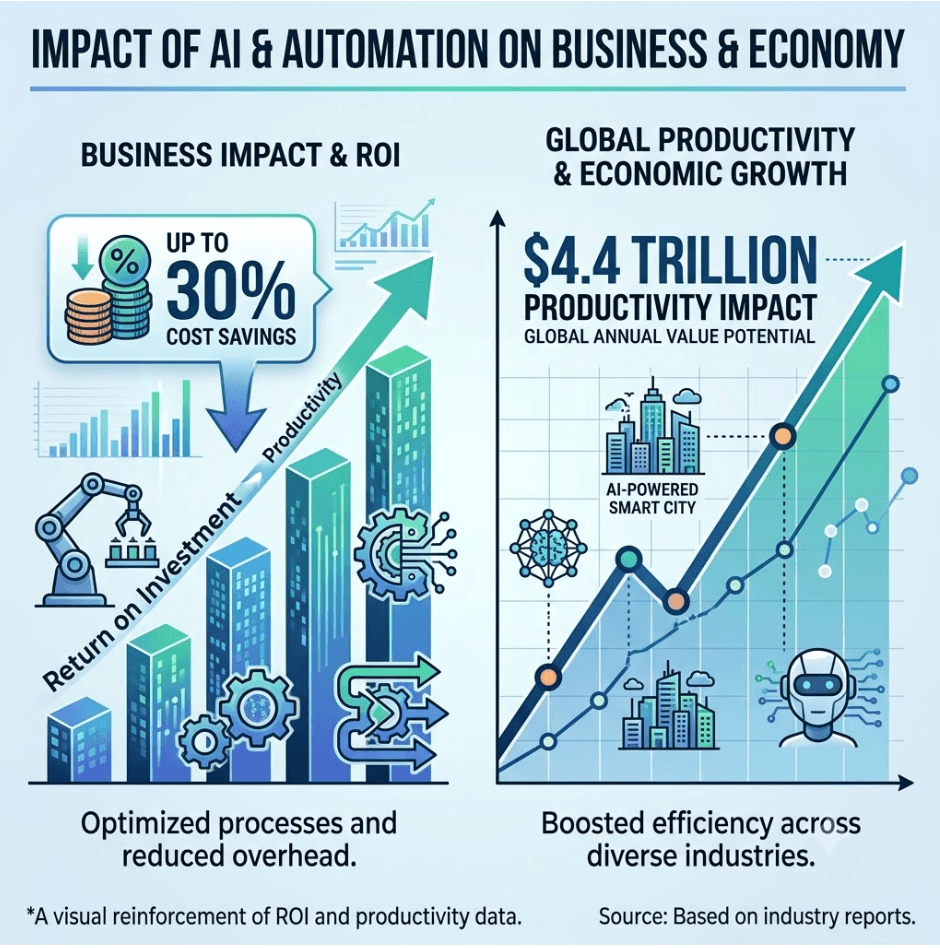
McKinsey's research on generative AI estimates the technology could add between $2.6 trillion and $4.4 trillion annually to the global economy across the 63 use cases the firm studied — a figure larger than the entire GDP of the United Kingdom. When generative AI's integration into existing software beyond those specific use cases is factored in, McKinsey estimates the impact could roughly double, reaching as much as $7.9 trillion annually. About 75% of that value is concentrated in four areas: customer operations, marketing and sales, software engineering, and R&D.
Zooming into a specific example makes the abstraction concrete. McKinsey documented a company with 5,000 customer service agents that used generative AI and saw a 14% increase in issue resolution per hour, along with a 9% reduction in the time needed to handle each issue. In functions like customer service, McKinsey estimates AI can increase productivity by 30% to 45% of current function costs — and could reduce human-serviced contacts by up to 50% in industries like banking, telecommunications, and utilities.
Beyond generative AI specifically, broader survey data reinforces the trend: businesses report roughly 30% cost savings on average after integrating AI into their operations, and in sectors like insurance, AI and machine learning-driven process automation is projected to save companies as much as $140 billion annually.
Efficiency gains show up everywhere, not just in customer service
Manufacturing: Companies that fail to adopt AI and robotics risk missing out on 30% to 50% of potential productivity gains, according to Bain & Company. Meanwhile, 80% of manufacturers are already using digital tools to optimize supply chains.
Cloud infrastructure: Nearly all organizations (around 90%) and 94% of large enterprises have adopted cloud-based technologies, and 95% of European companies report reduced IT costs and improved productivity as a direct result of cloud adoption.
AI adoption broadly: 72% of companies have already integrated AI into at least one part of their operations, and weekly generative AI usage in the workplace jumped from 37% in 2023 to 73% in 2024 — a sign that adoption is accelerating rapidly, not plateauing.
But there's an important caveat: adoption alone doesn't guarantee results
The data also delivers a sobering reality check. Despite near-universal AI experimentation, McKinsey's most recent State of AI research found that almost nine out of ten companies have deployed AI in at least one business function, yet 94% of respondents say they haven't seen "significant" value from those investments. Separately, IBM research has found that only about 25% of AI initiatives have delivered their expected ROI, and just 16% have successfully scaled enterprise-wide.
The pattern behind these numbers is consistent: organizations that treat AI as a bolt-on tool for isolated tasks see modest, often disappointing returns. Organizations that use AI to fundamentally re-architect how a workflow or process operates — rather than just automating a single step within an old process — see the outsized gains. This is precisely why "digital transformation" and "AI adoption" aren't synonyms. You can adopt AI tools without transforming anything meaningful. Real transformation requires rethinking the underlying process, not just accelerating the old one.
That distinction is also exactly where most organizations get stuck. They know AI is powerful. They may have already piloted a chatbot or an automation script. But they lack the internal expertise to know which processes are worth transforming, how to sequence the work, and how to avoid the expensive mistakes — underestimated integration costs, poor change management, and cybersecurity gaps — that derail so many transformation efforts.
Part 3: Closing the Expertise Gap — How Xcellent Life Helps Organizations Get This Right

This is exactly the gap Xcellent Life was built to close.
Many organizations understand, at least conceptually, that AI and automation represent a major opportunity. What they often lack is the practical, hands-on expertise to translate that understanding into a working plan — knowing which processes to automate first, how to integrate new tools with legacy systems, and how to manage the organizational change that comes with it. Xcellent Life's leadership team brings more than 100 combined years of experience in technology, having designed, built, and implemented systems and technology strategies that have helped organizations grow and operate more effectively and efficiently.
Rather than positioning AI as a one-size-fits-all product, Xcellent Life focuses on guidance and strategy: helping organizations figure out where automation and AI can realistically move the needle, and then building a concrete plan to get there. That includes flexible engagement models — from short, focused 1-hour and 2-hour discovery sessions to full project-based engagements — designed to meet organizations wherever they are in their transformation journey, whether that's early-stage exploration or a full-scale implementation.
Given how many companies are, as the data above shows, adopting AI without seeing meaningful returns, this kind of experienced guidance matters more than the technology itself. It's the difference between bolting AI onto an existing process and redesigning that process so AI actually delivers the efficiency and cost savings the data promises.
Bringing It All Together
Digital transformation isn't a trend that's going to fade — it's a structural shift in how organizations compete, operate, and grow. The financial case is compelling: multi-trillion-dollar productivity gains at the macro level, and real, documented efficiency improvements — often in the range of 30% or more — at the operational level for organizations that implement AI and automation thoughtfully.
But the data is equally clear that simply buying AI tools isn't enough. The organizations capturing real value are the ones that pair the technology with genuine process redesign and experienced strategic guidance. That's where partners like Xcellent Life come in — helping organizations move past the AI awareness stage and into a plan that actually delivers the cost savings and efficiency gains this technology makes possible.
If your organization is trying to figure out where to start, you don't have to figure it out alone. With decades of technology and automation experience, Xcellent Life offers a practical starting point: a discovery conversation to identify where AI and automation can create the most value for your specific operations.
Sources
IDC via WalkMe, 39 Digital Transformation Statistics for 2026 — https://www.walkme.com/blog/digital-transformation-statistics/
Market.us, Digital Transformation Statistics and Facts (2026) — z
eSparkInfo, Digital Transformation Statistics: Excellence Facts in 2026 — https://www.esparkinfo.com/software-development/digital-transformation/statistics
cFlow, 40+ Digital Transformation Statistics You Need to Know in 2026 — https://www.cflowapps.com/digital-transformation-statistics/
Shahid Shahmiri, 50+ Digital Transformation Statistics for 2025 — https://shahidshahmiri.com/digital-transformation-stats/
McKinsey & Company, The economic potential of generative AI: The next productivity frontier (2023) — https://www.mckinsey.com/capabilities/tech-and-ai/our-insights/the-economic-potential-of-generative-ai-the-next-productivity-frontier
McKinsey & Company, The state of AI in 2025: Agents, innovation, and transformation — https://www.mckinsey.com/capabilities/quantumblack/our-insights/the-state-of-ai
McKinsey & Company, AI productivity gains and the performance paradox (2026) — https://www.mckinsey.com/capabilities/strategy-and-corporate-finance/our-insights/where-ai-will-create-value-and-where-it-wont
A-Listware, Digital Transformation for Cost Savings: 2026 Guide (citing IBM AI ROI research) — https://a-listware.com/blog/digital-transformation-for-cost-savings
Link to Xcellent Life: http://xcellentlife.com/